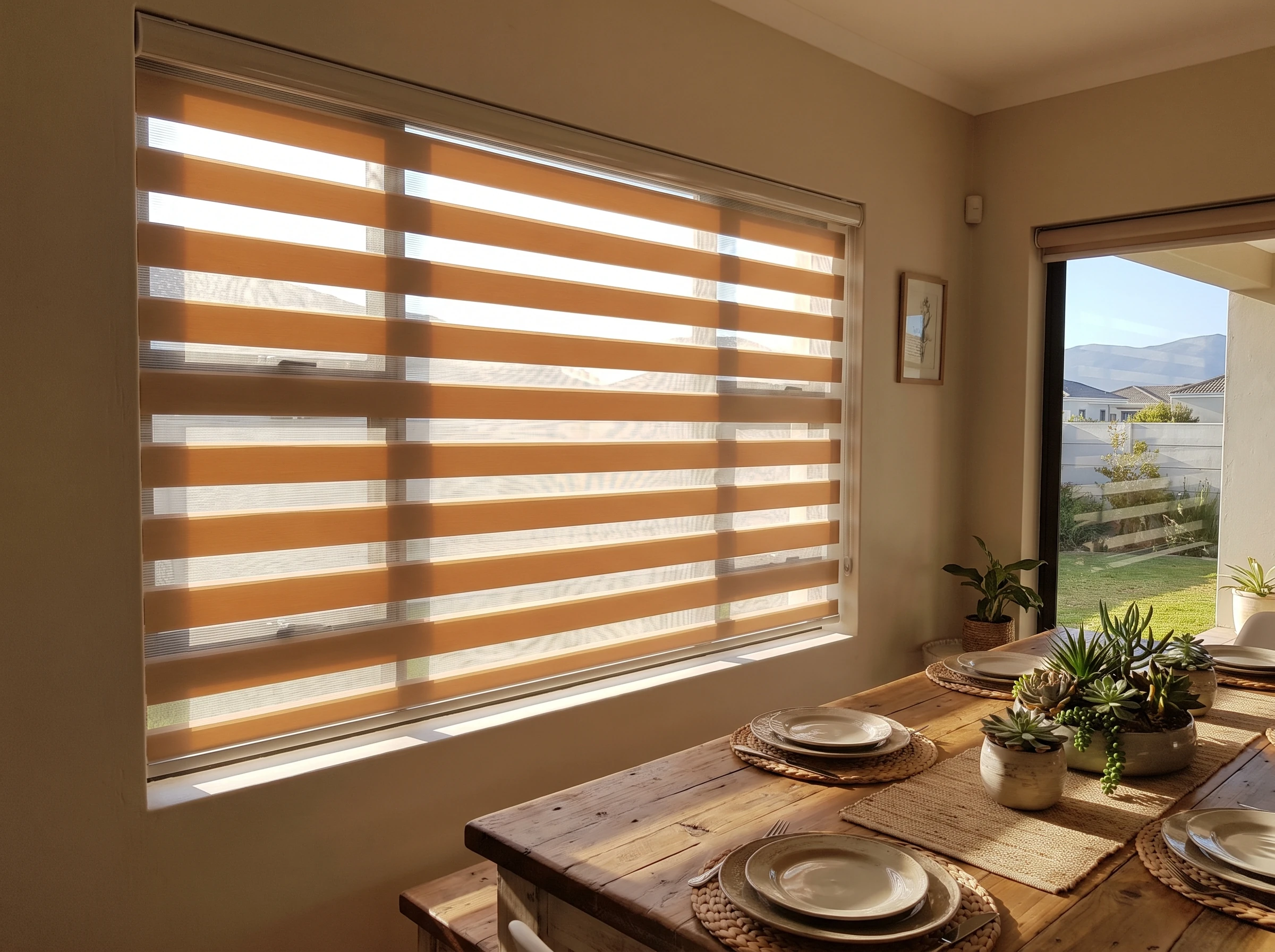
The living-room answer to a road-facing living room
New-estate living rooms in Kraaifontein are usually open-plan, and the wide sliding door onto the front garden or the street is often the single largest piece of glass in the house. A day-night blind lets you align the sheer and solid bands for filtered light and a soft, privacy-with-view look through the day, then offset them toward evening once the room is lit and the glass would otherwise turn into a lit stage from the street. It's the fabric equivalent of a sheer curtain and a blind in one bracket.
Not a full blockout — and that's fine for the right room
Even fully offset, a zebra blind still lets a little light seep at the band edges, so it isn't the answer for a bedroom that needs total dark on a winter morning — a blockout or double roller handles that better. Where a day-night blind earns its place is a living room, dining room or open-plan kitchen that wants light control and privacy through the day rather than darkness at night.
Fitted the same way as a roller, with the same fixing choices
Day-night blinds run on standard roller hardware — chain or motorised, cassette or face-fixed, inside or outside mount. A new-estate wall in Zonnendal or Camelot usually takes a straightforward inside-mount bracket into fresh plaster; an established Windsor Park or Zoo Park frame sometimes needs a face-fixed cassette instead. We confirm which on site rather than assume.
A day-night blind is the one product that answers both halves of an open-plan living room's brief — light through the day, privacy once the lights go on.
On-site measure, Kraaifontein- Alternating sheer and solid bands on a continuous loop
- Light-filtering through to semi-blockout fabric ranges
- Chain or motorised control, cassette or face-fixed
- Best suited to living, dining and street-facing rooms — not a bedroom blockout substitute
Ready to measure your windows?
Free in-home measure, written per-window quote, no obligation.